
Loss Aversion
Why Losing Hurts Way More Than Winning Feels Good
⏱️ Reading time: 4.5 minutes
📌 Key Insights:
People value what they already own more than what they stand to gain
Highlight losses, not just gains, to persuade more effectively
Use loss-framed language to create urgency and drive action
Hello Captivate Community,
One monthly persuasion tip, distilled from psychology and behavioural science. Elevate your communication and impact in only 5 minutes.
Our Promise - keep it CIA. Concise, Insightful and Actionable!
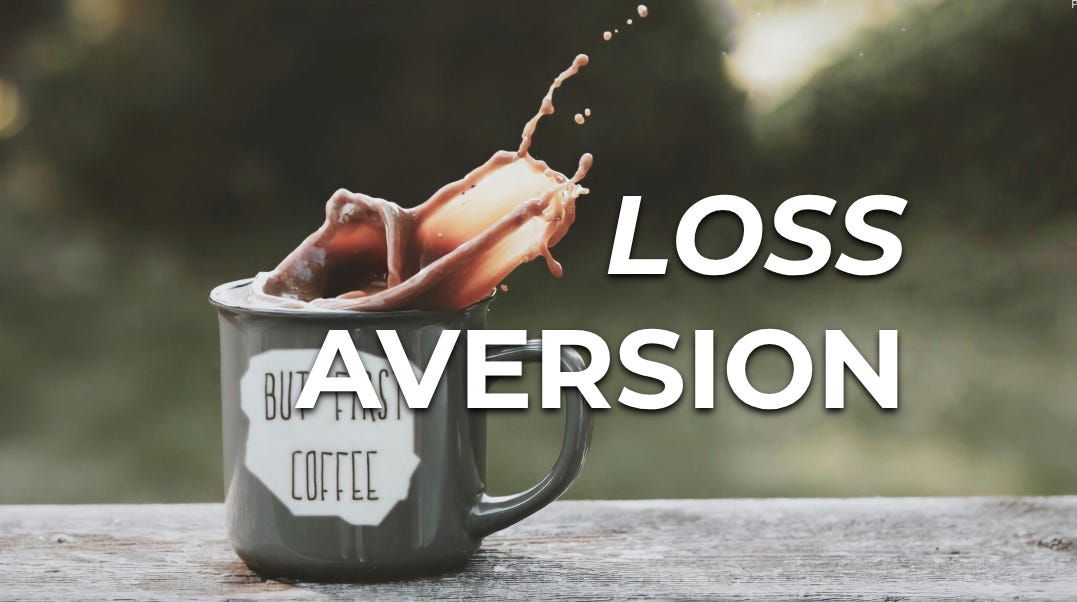
Picture two people in a room. One is given a plain old coffee mug - nothing fancy, probably says ‘World’s Okayest Employee’ on it. It’s theirs to keep. The other just looks at it and guesses what they’d pay for it. Usually, they say $3. But ask the new owner what it would take to part with it, and the price doubles to around $7.
This isn’t just a hypothetical - it’s a classic experiment by Daniel Kahneman that nails Loss Aversion. The moment that mug becomes theirs, losing it feels twice as painful as gaining it. Our brains are wired to protect what we have, not chase what we want. The “ouch” of a loss is way bigger than the “hey, cool” of a gain. Evolution made us hoarders, not gamblers.
Too often, we pitch only the perks, fighting with one hand tied behind our back. To truly persuade, you need to show what they stand to lose if they don’t act.
Once you get this, you’ll see opportunities everywhere. Here are three powerful tactics.
1. Focus on the “Cost of Inaction” (COI)
ROI is nice, but can be hard to imagine clearly. Future promises feel hypothetical. Current bleeding feels real. COI? That’s real, urgent pain. Instead of “This saves $50K annually,” say: “Waiting costs you $4,000 every month.” Framing the status quo as a leak in their wallet makes your solution the plug they need now.
2. Give it, then take it away
Forget “10 percent off.” Try: “We’ve credited your account with $50 - expires in 48 hours.” That money? It’s already theirs. Letting it slip away feels like losing cash from their own pocket. Possession is nine-tenths of psychology.
3. The “Test Drive” Strategy
Software loves free trials - and for good reason. Once users set up profiles, invite teams, and customize dashboards, it’s no longer “just a tool.” It’s their workspace. When the trial ends, saying goodbye feels like a real loss. Most prefer paying instead of starting over from scratch. After all, nobody wants to explain to their team that all their work just vanished because you were too cheap for the subscription.
Here’s a quick experiment that will make you cringe at your current approach: Pull up your top sales deck, LinkedIn post, or that email you’ve been polishing for your boss. Find one “gain” statement (like “We’ll be more efficient”) and flip it into a “loss” statement (like “We’re wasting 10 hours a week on manual work”).
Use that loss-framed version next time. Watch how people react when you talk about what’s being wasted, not what’s being gained. Make them squirm a little. Not enough to seem like a fear-monger, but enough that staying put suddenly feels riskier than saying yes.
Let’s Chat
Got a Loss Aversion story? The one that got away? Ever played it too safe and regretted it? Or used the “Cost of Inaction” to close a stubborn client?
Hit reply. We’ll share the best stories - anonymously, of course.
Want to Learn More? Check out these Great Resources:
The original research by Kahneman and crew, including the coffee mug experiment, are all covered in the paper titled “Anomalies: The Endowment Effect, Loss Aversion, and Status Quo Bias” that can be found here.
For a less academic overview, check out Daniel Pink’s To Sell Is Human, which includes a deeper dive on the Cost of Inaction method.
As always, thanks for reading this month’s edition.
See you in June.
I think THAT 'loss theory' is maybe the most intuitive lessons I've ever encountered. So, is it true that 'loss eclipses gain'? Is wealth gain to most people 'not worth it'? For me, losing is more serious than gaining.
Personally, I just don't value 'gain'. This is why
I can accept gain from work, or small investment.
Then, I'm always guarding never increasing. Increasing feels threatening, more I must 'guard'.
This is a key topic, one I do but don't understand. You're onto the substance.